

Chin Filler Isn't About Having a Bigger Chin

Updated: Jul 28
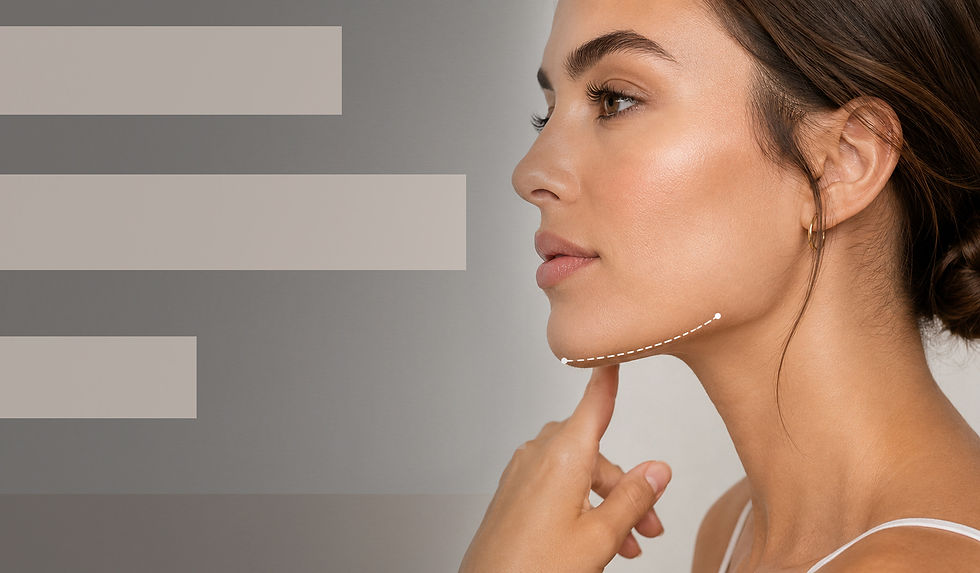
If there's one treatment patients are surprised by during a facial balancing consultation, it's chin filler.
Almost no one books an appointment saying, "I think I need my chin done."
Instead, they're thinking about their lips, their jawline, or maybe even their nose. But once we step back and look at the face as a whole, the chin often becomes one of the most important pieces of the conversation.
That's because the chin does a lot more than people realize.
Why the Chin Matters More Than You Think
Think of the chin as the anchor of the lower face.
If it sits a little too far back, it can change the way everything around it looks. A nose may appear more prominent. The jawline may look softer. The neck can seem less defined. Even the lips can look like they're sitting farther forward than they actually are.
The interesting part?
Nothing about those features changed. It's simply how your brain interprets facial proportions.
That's why sometimes the biggest improvement doesn't come from adding more filler to the lips or defining the jawline. It comes from giving the chin just enough support to bring everything into better balance.
Facial Balancing Isn't About Treating One Area
One of the biggest misconceptions about facial balancing is that it's a treatment.
It isn't.
Facial balancing is the way we evaluate your face before recommending any treatment.
Instead of looking at one feature in isolation, we ask questions like:
Does the chin provide enough support for the lower face?
Are the lips proportional to the chin?
Would improving the chin make the nose appear more balanced?
Does the jawline flow naturally into the chin?
Sometimes the answer is yes.
Sometimes it isn't.
And sometimes the recommendation isn't filler at all.
The goal is never to convince someone they need another syringe. The goal is to recommend only what's going to make the biggest difference.
The Biggest Misconception About Chin Filler
Many people hear "chin filler" and immediately picture a longer, sharper, or noticeably larger chin.
That's usually the opposite of what we're trying to achieve.
Most chin filler treatments are subtle.
We're often adding just enough projection or length to improve the relationship between the upper and lower face—not to create a dramatic change.
In fact, one of our favorite compliments patients receive is:
"I can't tell what you did, but you look great."
Those are usually the best results.
The Chin Can Change the Way Other Features Look
One of the reasons we love treating the chin is because it can improve the appearance of other areas without touching them.
For example:
A nose that feels too prominent
A patient may think they need rhinoplasty or spend years feeling self-conscious about their profile.
Sometimes, improving chin projection creates better balance between the nose and chin, making the nose appear less prominent without changing the nose itself.
Lips that seem too projected
Patients occasionally ask us to dissolve their lip filler because they feel their lips stick out too much.
In some cases, the issue isn't the lips.
It's that the chin sits farther back, making the lips appear more prominent than they really are.
Adding support to the chin can completely change that relationship.
A jawline that lacks definition
Patients often assume they need jawline filler.
Sometimes they do.
Other times, improving the chin creates a stronger endpoint for the jawline, making the entire lower face look more defined with less product.
How We Decide if Someone Could Benefit
There's no measurement that automatically tells us someone needs chin filler.
We look at your face from multiple angles, both at rest and while you're talking or smiling.
We also ask about your goals.
Some patients want a stronger profile.
Others simply want their face to feel more balanced in photos.
And some patients decide they don't want chin filler after discussing it—and that's completely okay.
The consultation is about education, not persuasion.
Less Is Usually More
One of the biggest surprises for patients is how little filler can make a noticeable difference.
For many people, one to two syringes is enough to improve projection and definition while still looking completely natural.
We'd almost always rather start conservatively and build over time than do too much in one appointment.
The goal isn't for people to notice your chin.
It's for them to notice your face looks more balanced without being able to explain why.
What Should Chin Filler Actually Look Like?
Good chin filler shouldn't be obvious.
It shouldn't look pointy.
It shouldn't make you look like a different person.
And it certainly shouldn't make people immediately think you've had filler.
The best results simply look like the chin belonged there all along.
Is Chin Filler Right for Everyone?
No.
Some patients benefit much more from treating another area first.
Others already have good chin projection and don't need filler there at all.
That's why we don't believe in treating every patient the same way or following social media trends.
Every recommendation starts with your anatomy, your facial proportions, and what you're actually hoping to improve.
Getting Started
Chin filler is one of the most overlooked treatments in aesthetic medicine—not because it creates dramatic results, but because it often creates the kind of results people can't quite put their finger on.
A small amount of filler in the right place can change the way the lips, nose, jawline, and lower face relate to one another.
That's why, during a facial balancing consultation, the chin often becomes part of the conversation—even when it wasn't the reason you booked the appointment.
The goal has never been to create a bigger chin.
It's to create a face that feels naturally balanced, with each feature supporting the next.


Comments