

How Often Should I Get Botox or Dysport?
- SEAPORT MEDSPA

- Dec 17, 2025
- 3 min read

Botox and Dysport are two of the most effective and widely used treatments for softening fine lines and dynamic wrinkles. One of the most common questions patients ask is simple but important: how often should I get Botox or Dysport to maintain results without overdoing it?
The answer depends on several factors, including how your body metabolizes the product, the areas treated, your muscle strength, and the technique used by your injector. Understanding these variables can help set realistic expectations and lead to consistently natural-looking results.
How Botox and Dysport Work
Both Botox and Dysport are forms of botulinum toxin type A. They work by relaxing targeted facial muscles that create repetitive movement—such as frowning, squinting, or raising the eyebrows. By softening muscle activity, the skin above appears smoother and more refreshed.
While Botox and Dysport work similarly, Dysport tends to spread slightly more, which can be ideal for certain areas like the forehead. The choice between the two is often based on anatomy, movement patterns, and injector preference rather than a strict rule.
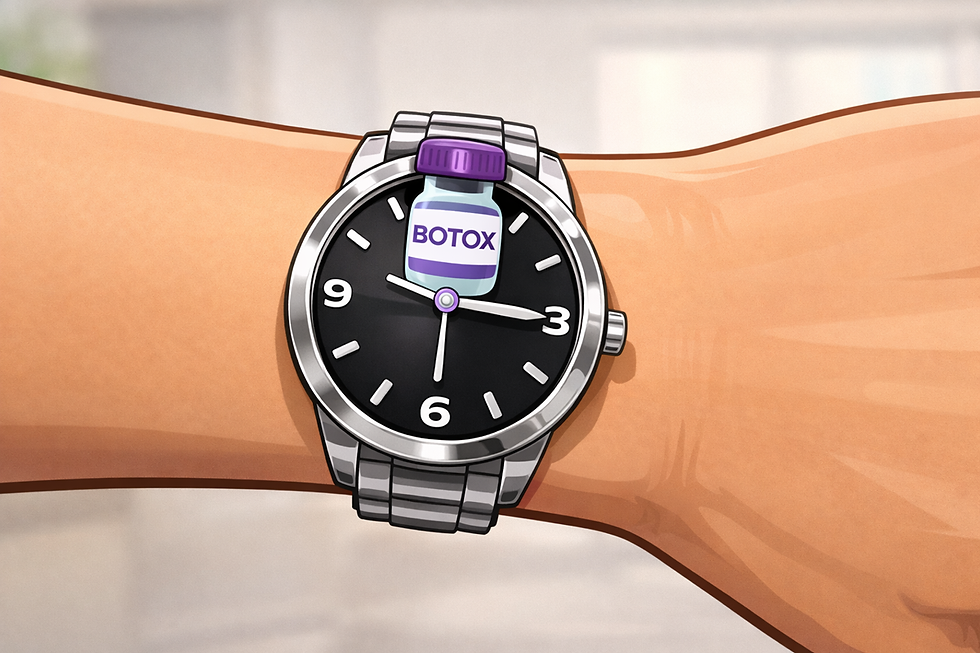
The General Rule: Every 3 to 4 Months
For most patients, Botox and Dysport last about 3 to 4 months. This timeline reflects how long it takes for nerve signaling to gradually return and muscle movement to resume.
That said, this is a guideline—not a one-size-fits-all rule.
Some patients notice their results lasting closer to 4 months, while others may see movement return a bit sooner.
Factors That Affect How Often You’ll Need Treatment
1. Your Muscle Strength
Stronger facial muscles—often seen in the forehead or jaw—can metabolize neuromodulators faster. Patients with very expressive faces may need a higher Botox or Dysport unit treatment.
2. The Area Treated
Different areas of the face wear differently:
Forehead and frown lines: typically 3–4 months
Crow’s feet: often closer to 4 months
Lower face Botox (DAO, lip flip, chin): may wear off a bit sooner due to frequent movement
3. Your Metabolism & Lifestyle
High levels of physical activity, fast metabolism, and frequent facial movement can all shorten longevity slightly. This doesn’t mean Botox or Dysport won’t work, it just means unit dosing may need an adjustment.
4. Injector Technique
Strategic placement, correct dosing, and advanced technique matter more than people realize. Well-placed neuromodulator treatments often last longer and look more natural than higher doses placed without precision.
Is It Bad to Get Botox Too Often?
Receiving Botox or Dysport too frequently, such as every 6–8 weeks, is generally unnecessary and not recommended. Treating too often can increase the risk of developing resistance over time and doesn’t allow muscles to fully respond and reset.
Most providers recommend waiting at least 12 weeks between full treatments. Touch-ups, when appropriate, are typically evaluated around the 2-week mark after your initial appointment—not weeks later.
Can Waiting Too Long Be a Problem?
Waiting longer than 4–5 months isn’t harmful, but patients may notice that lines return more prominently if treatments are inconsistent. Regular maintenance helps prevent deepening of dynamic lines over time.
That said, Botox and Dysport are not “all-or-nothing” treatments. If you miss an appointment or decide to take a break, your face will simply return to its natural baseline—nothing worse.
Preventative vs. Maintenance Botox
Preventative Botox
Younger patients or those just starting may choose Botox or Dysport to minimize repetitive muscle movement before lines become etched into the skin. These patients often require smaller doses and may go longer between visits.
Maintenance Botox
Patients treating existing lines often benefit from more consistent scheduling—usually every 3 to 4 months—to maintain smoothness and prevent lines from becoming deeper over time.
Both approaches are valid and should be tailored to individual goals.
Botox vs. Dysport: Does One Last Longer?
Longevity between Botox and Dysport is generally comparable. Some patients feel Dysport kicks in slightly faster, while Botox may feel more precise in smaller areas. Neither consistently outperforms the other in duration when used correctly.
The most important factor isn’t the brand—it’s the experience and judgment of the injector.
Finding Your Ideal Schedule
The best way to determine how often you should receive Botox or Dysport is through a customized treatment plan. Most patients land comfortably in a 3–4 month rhythm, adjusting slightly based on how their results evolve.
Over time, many people notice:
Results lasting longer
Needing fewer units
More balanced, natural movement
This is a sign of thoughtful treatment—not overcorrection.
Key Takeaways
Botox and Dysport are highly effective when used strategically and consistently. Rather than chasing a rigid schedule, the goal is to respond to your face, your movement, and your results.
A personalized approach, guided by expert technique—helps ensure refreshed, natural-looking outcomes that evolve with you over time.
If you’re unsure when to schedule your next visit, a professional evaluation can help fine-tune the timing so your results always feel like you, just well-rested.

Comments